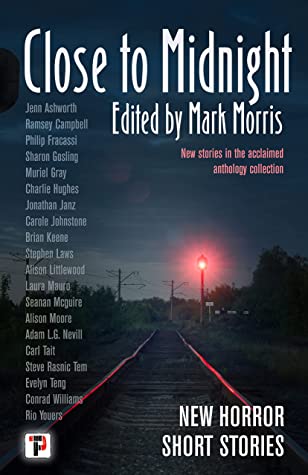
Close to Midnight is the third entry in this annual series of original horror anthologies published by Flame Tree Press and edited by Mark Morris. Like previous volumes, the contributions come from a superb array of leading contemporary authors, plus a couple carefully selected from work submitted during an open submission window. As I noted in my reviews of After Sundown and Beyond the Veil, this is a perfect way of ensuring quality whilst also allowing an opportunity for emerging writers, something that helps keep the genre fresh and progressive.
Although this anthology is a non-themed, it’s natural that a global event such as the Covid pandemic will undoubtedly have influenced the tone of the stories, so it’s no surprise to see that many of the entries touch on loss – both literally and metaphorically – as well as a lack of control. Rather than being a negative, this actually gives the anthology a loose connective thread, and illustrates, through a superb diversity of quality prose, how the past few years have affected our lives.
As with any collection of short fiction, I should qualify things by saying that not all will work for every reader. I preferred some to others, as is my personal taste, and I’m sure every reader will have differing favourites. That’s the nature of anthologies and short story collections, and this personal divergence is one of the reasons I enjoy them so much. However the overall quality of stories in Close to Midnight is incredibly high, so much so that I wouldn’t be surprised to see a couple of them make the annual Best Of lists for 2022.
Rather than going through each tale separately I’ll just highlight a couple that stood out for me in particular. Alison Littlewood’s In the Wabe details a mother’s anguish over her five year old daughter Vivian, who vanished one day in Central Park. References to Alice’s Adventures in Wonderland are alluded to, and the story has some superb elements of the uncanny as it messes with age and perception. It does a brilliant job of reminding us of how quickly life goes by. It’s a story tinged with regret, but it works both as an example of weird fiction and also as a dark unsettling reminder of what we once were and what we will eventually become.
I Promise by Conrad Williams is a quiet piece, telling the story of Alex, grieving the death of his father, and how the whole process is taking its toll on his relationship with his girlfriend. Beneath the darkness there’s an honesty to the prose that will resonate with anyone who has lost a parent.
Jenn Ashworth’s Flat 19 deals with a woman struggling under the weight of being the woman she is expected to be – a wife, mother, work colleague, and other facets of her personal and creative life that she is trying to juggle. Eve takes the opportunity to escape this mundanity for a while, and possibly comes to regret the decision. It’s an engaging story, and says much about a woman’s role in the modern world.
Remains by Charlie Hughes is one of the best ghost stories I’ve read in years. It’s a chillingly sad tale, narrated by a murder victim whose body has been concealed in the urban wasteland of London’s Crofton Station. I loved the omnipresent narrator. It’s an elegiac story, and one that says so much about life in its brief wordage. I found myself thinking of this one long after I had finished the anthology, and it alone justifies the price of the book. Brilliant stuff.
Alison Moore’s Welcome to the Lodge is another entry tinged with melancholy and imbued with a strange dreamlike quality, as Helena visits a sleep disorder clinic in an effort to rid her of her nightmares. As ever, Moore never puts a foot wrong, treading a fine line between leaving things to the reader’s interpretation and giving us just enough hints to touch on the numinous.
Rise Up Together by Adam LG Nevill – the final, and longest story, in the anthology – is about a man’s trip to an out of the way coastal town to see an old friend. The unsettling details of the story are carefully built, and like any good weird tale, subtle and cumulative in their impact. This is another story that deals with a loss of control and touches on the events that take place outside of our understanding. It’s a fine tale to finish off what is a great collection of horror stories.
Close To Midnight illustrates what great shape the genre of horror is in. This series from Flame Tree Press seems to be getting better and better each year. There is much to look forward to. If you’re a reader who enjoys quality fiction of the dark kind, this is a series to be cherished. There isn’t a bad story in the entire book. Here’s hoping that it does well enough for the series to continue. Highly recommended.

