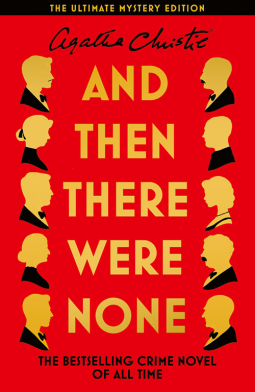
Agatha Christie’s 1939 novel And Then There Were None is widely acknowledged to be the bestselling crime novel of all time. And it’s easy to understand why. Eight seemingly unconnected guests travel to a remote island off the coast of Devon – upon which lies a solitary house – where they are met by a couple who have been employed as housekeepers. Their mysterious host – U N Owen – is nowhere to be seen, and the quests quicky realise that not one of them has actually met him (or here). On the first evening one of the guests dies quite suddenly, plunging the remaining characters into a nightmarish plot of murder and deceit. They are being executed, one by one, in a manner in tune with the childhood nursery rhyme that adorns the walls of their room.
This novel is so famous it has pretty much become a touchstone of Western pop culture, at least in the crime genre. Agatha Christie herself described the novel as one of the most difficult to write, given that she had to account for all of the various twists in the storyline, whilst at the same time not just disguising the identity of the killer from the reader, but also by totally wrongfooting the reader so that the final solution comes as much a shock as it would have to the poor unfortunate victims of the killer. Like most of Christie’s work, there is little in the way of characterisation – she could never be accused of padding out her novels with unnecessary detail – but it seems churlish to criticise, when what makes Christie’s stories work so well is her masterful plotting. In fact, nearly fifty years since her death, I have yet to read a mystery writer more accomplished in their plotting than Agatha Christie.
This version of the novel – the Ultimate Mystery Edition – has the novelty of that its final chapter is delivered in a rather interesting manner – via a sealed document inside the printed book, and by email once an attempt to solve the crime has been made in the e-version. This novelty adds little to the book’s charm. If anything, its final chapter accentuates the very clumsiness that Christie herself fought against. It feels almost tacked on, even though it quite clearly isn’t, although it does come across as a bit awkward, similar to the exposition dump at the ending of Psycho.
And Then There Were None is a truly remarkable novel, and there have been many cinematic and television adaptations over the years – but most of these utilise Christie’s rewritten 1943 version which changed the rather bleak original ending into something more palatable for stage audiences (and the superb Rene Clair film from 1945). So to readers unfamiliar with the original story, the novel might come as something of a surprise. And it’s a very claustrophobic book, with an overriding sense of futility and the inevitability of death, possibly the effect of it being written during the Second World War. The spectre of death feels very close. I’ve read this several times over the years and it’s a novel that never fails to thrill. Highly recommended.
 stephenbacon.co.uk